


AI rewrote the rules of attention and loyalty. VMF Dubai will put them to the test
Marketing leaders will share strategies to deal with rapid technological change, dynamic market conditions, and dwindling customer trust.
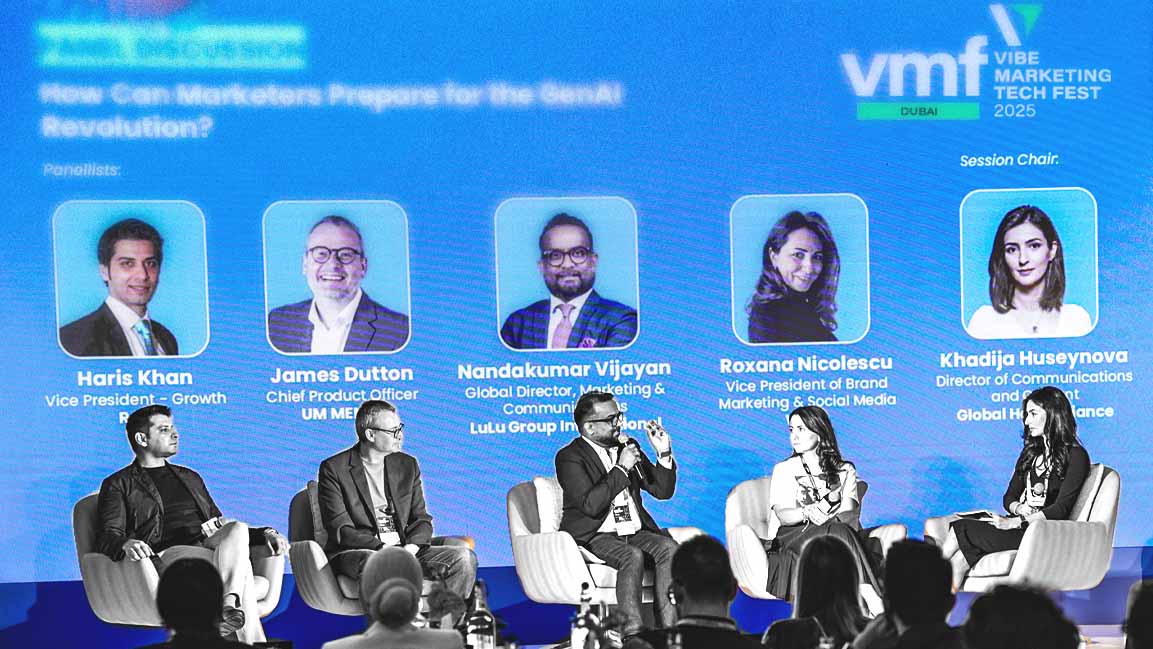


When Vibe Marketing Tech Fest was first established in 2018, the organizers, Martechvibe, saw it as a way for the marketing community to get an insider’s view into how leaders are thinking through emerging technologies and shifting strategies.
Over the years, the event has evolved alongside the industry. What began as an event to explore marketing technology has matured into a meeting ground for senior business leaders, marketers, technology experts, and innovators tackling the biggest questions around growth, CX, AI, data, and digital transformation.
Today, VMF is recognized as one of the Middle East’s leading gatherings for marketing and technology leaders, bringing together decision-makers to exchange practical insights, challenge conventional thinking, and shape the next chapter of the marketing landscape.
Speakers such as Scott Brinker, Sir Martin Sorrell, Brian Solis, Neil Patel, Darell Alfonso, Fernando Machado, David Raab, Rob Bloom, and Steve Lok have delivered rich sessions at previous editions of the summit.
This year’s edition holds true to that vision. In 2026, marketing teams are going through the largest upheaval of all time – the future of work itself is being reimagined. The conversation around artificial intelligence means business leaders must upskill teams and revisit leadership training to create a new cadre of data-driven, customer-centric, AI-enabled leaders to propel their business into a future that’s still being written. For brands to reach customers in an era of information overload, attention is harder to earn, and trust is harder to keep.
At the Vibe Marketing Tech Fest stage, industry veterans will discuss these shifts and how to implement strategies that embrace new realities while staying grounded in foundational truths. For example, while Akshay Singh, Vice President Retail Media Product & Monetization, Majid Al Futtaim, will speak about using AI to generate and test creative variations at scale, Kevin Chesters, Strategic Consultant, Keynote Speaker and the Author of The Creative Nudge, will conduct an interactive session on The Enduring Rules of a Perfect Story.
The evolving discourse for marketing leaders to consider includes: Aligning Brand Behavior with Customer Belief, What Real-Time Marketing Looks Like Behind the Scenes, Reimagining Loyalty through Co-creation, The New Science of Segmentation, Retail Media’s Evolving Role in Brand Building, Budgeting for What Matters Most and Measuring What Matters When ROI is Under Scrutiny. Each of these conversations finds a place on the two-day agenda. It’s time for an honest conversation about the big shifts;
WHAT IS THE ROLE OF THE FUTURE MARKETING LEADER?
Historically, marketing was responsible for brand, communications, and campaigns. That’s not the role I’m seeing today, says Ilaria Buonpane, Chief Marketing Officer at Wear That, part of the Chalhoub Group. “The best CMOs now sit at the intersection of customer, product, technology, data, commercial performance, and growth. They’re often one of the few executives with visibility across the entire customer journey, from acquisition all the way to retention and advocacy.”
Ilaria will take the stage with Eslam Mohamed, Chief Marketing Officer at Ali Al Mulla Group, and Naomi Mendez, Chief Marketing Officer at Emirates Hospitality, to discuss how leaders plan, sense-check campaigns, reinforce teams, and prioritize customer flexibility in changing realities.
The CMO’s role has gone through considerable iterations within the enterprise. Does this mean CMOs make for good future CEOs? George Yaryura, Senior Vice President, Marketing at Mashreq, Jamie Buchanan, Senior Brand & Marketing Leader, Zia Rahamat, Director of Growth & Analytics at Anghami, Yara Milbes, SVP Marketing & Growth at Lucidya and Joy Dabeet, Chief Marketing Officer at amana will discuss it on day 2 of VMF Dubai.
ATTENTION IS NOT THE SAME AS INFLUENCE
“An impression tells us that content was served, it does not tell us whether someone noticed it, understood it or remembered the brand,” explains Roxana Nicolescu, VP Brand Marketing & Social Media, Wego.com. “Current industry measurement standards distinguish viewability, the opportunity for an advertisement to be seen, from attention, which assesses whether it was genuinely noticed or engaged with. Attention is not necessarily disappearing, it is becoming more fragmented, selective and rapidly reallocated between feeds, creators, searches, messages and cultural moments.”
The path between discovery and conversion is getting more convoluted. How can brands strive to have a seamless narrative that carries across channels?
Imagine someone scrolling through social media with no immediate intention of traveling, says Roxana. A creator shares a quiet beach, a local restaurant or an unexpected weekend destination, and within seconds the viewer saves the post. A few days later, they search for the destination, compare flights and send the idea to a friend. The original content may have generated only a few seconds of attention, but it started a much longer decision journey. “This is why we need to understand where attention is clustering, around which trends, creators, conversations and cultural moments, and then connect that attention to saves, branded searches, qualified visits, consideration and ultimately bookings.”
Roxana will join a panel on, how to build for customers who don’t think in channels but in experiences, with fellow speakers Mohamad Al Rayes, Director of Growth at YallaMotor, a part of Bayt.com, Arjun Sarkar, Vice President, Digital Ecosystem & Partnerships at Dubai CommerCity, Dharani Dharan G, Director of Product Management at Careem and Mohamed Al Awadhi, VP, Personal Banking Marketing at First Abu Dhabi Bank.
AI MAKES LTV ACTIONABLE AT A GRANULARITY THAT WAS PREVIOUSLY IMPOSSIBLE
Artificial Intelligence will shift LTV from a backward-looking cohort average to a forward-looking individual signal, which changes what you can do with it operationally, says Alvaro Martinez, Sr. Director MENA – Growth Marketing and Pricing at talabat.
Currently, most LTV models produce segment-level outputs: Customers acquired via channel x in market y have an average 6-month LTV of z. That’s useful for budget allocation but not for real-time intervention. Predictive modeling at the individual level changes the decision surface.
Churn prediction becomes preventive rather than reactive; you intervene at day x when the signal appears, not at day y when the customer has disengaged
NBA (Next Best Action) engines can use predicted LTV as a weighting variable, so high-LTV-potential customers receive disproportionate investment in their early lifecycle
Pricing personalization can be calibrated against individual LTV curves, you don’t need to offer a blanket discount to re-engage; you can size the incentive to the expected return
Alvaro will join Gaurav Sinha, International Marketing Director – AMEA at Domino’s, and Hira Omar Aamer, Brand Strategy Director at The Coca-Cola Company, to talk about how participation, peer influence, and social validation can strengthen loyalty more than price-based offers.
The honest constraint is data quality and model refresh cadence. A monthly predictive LTV model is already partially stale in a category with daily/weekly ordering cycles. The real unlock is when predictions update in near-real time and feed directly into CRM and paid media decisioning.
“AI doesn’t make LTV a better metric; it makes LTV actionable at a granularity that was previously impossible. The teams that will win are the ones that close the loop between the prediction and the intervention, not just the ones that build the model,” says Alvaro.
CUSTOMERS WANT TO FEEL UNDERSTOOD
“The future belongs to whichever interaction, human or AI, creates the most confidence,” offers Ilaria.
For instance, Harry Lonergan, Digital Marketing Director at Chalhoub Group, will speak about the shift from persona-based to behavior-based segmentation.
“The most successful brands use logic to enable magic: they use data, technology, and AI to understand context, anticipate needs, remove friction, and make better decisions. The goal is to create experiences that feel effortless, personal, and relevant. Because knowing my name, birthday, and purchase history doesn’t create loyalty, but recognition. Loyalty happens when a customer feels understood.”
Vibe Marketing Tech Fest will take place on September 9 and 10th at the Hilton Palm Jumeirah. Follow the link for registration and the full agenda.

Featured Videos
Today's Top Stories:
More Top Stories:



FROM OUR PARTNERS