
- | 9:00 am
Nature is MENA’s next tourism frontier. But how much is too much?
The region is opening its wildest corners to travelers—and testing whether growth and preservation can coexist on the same fragile ground.
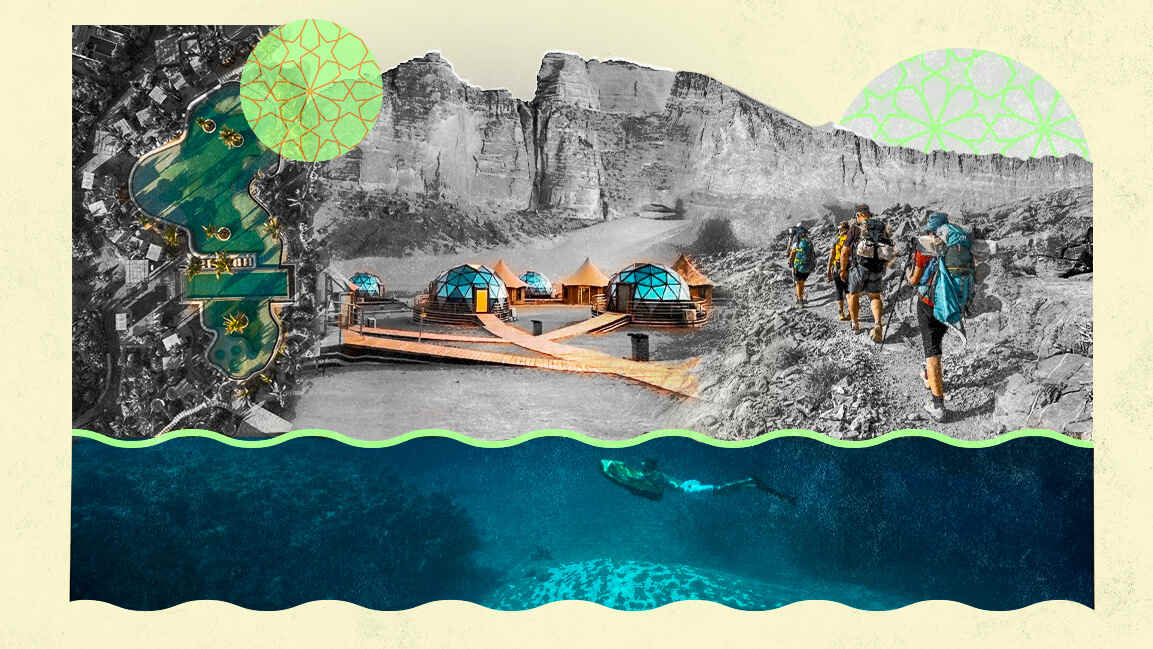


Before nature tourism becomes another volume business, the Middle East has a rare chance to decide how many visitors its most fragile landscapes can carry. Saudi Arabia, Oman, Egypt and Jordan are opening coastlines, deserts and mountain reserves to travelers—while testing whether the rules that protect those places can be written before demand outruns them.
From Saudi Arabia’s renewable energy-powered Red Sea megaprojects and Oman’s low-density mountain reserves to Egypt’s ecotourism developments in South Sinai, the region is actively steering travelers away from familiar urban centers and into the wild. With nearly 100 million travelers visiting the Middle East in 2025, operators are eager to capitalize on the region’s massive visitor base.
While the commercial opportunity is clear, the environmental equation is far more complex.
Many of these destinations sit in habitats already strained by extreme heat, water scarcity, and human activity, creating an inherent paradox: Can tourism generate enough revenue for conservation without destroying the landscapes that draw visitors in the first place?
DESIGNING FOR CAPACITY BEFORE DEMAND
Saudi Arabia offers the region’s boldest test of this balancing act. At Red Sea Global (RSG), renewable microgrids and battery storage were designed into the destinations from the start. Across its Red Sea operations, the developer says independently verified renewable-energy and low-carbon operations avoided 117,879 tonnes of CO₂e in 2024.
But minimizing harm is no longer enough; the evolving mandate is regenerative travel. RSG is currently targeting a 30% net conservation gain by 2040. On the ground, this means establishing the 5,015-square-kilometer Al Wajh Lagoon Fishery Management Area, planting millions of mangroves, treating wastewater through constructed wetlands, and restoring coral fragments.
Managing visitor volume is equally central to this strategy. AMAALA, for instance, has instituted an explicit ceiling of 500,000 guests per year, setting a physical boundary on ecological pressure.
Carolyn Turnbull, CEO of Nammos Hotels & Resorts—which is soon opening a 110-room property at AMAALA—argues that such limits are essential to preserving true exclusivity.
“The clearest lesson from global mass tourism is that capacity has to be designed in at the beginning,” says Turnbull.
“Demand for genuinely beautiful places is close to inexhaustible, and it does not moderate itself. Approaches that rely on market forces to regulate visitor numbers consistently find that the market has no interest in doing so. When volume becomes the primary metric, the destination inevitably fractures.”
For developers, this cap changes the business model. If visitor growth cannot scale indefinitely, revenue must be driven by yield and value: longer stays, repeat guests, premium experiences, and localized supply chains.
THE ECONOMICS OF RESTORATION
Regeneration means leaving an ecosystem healthier than before—not simply reducing a resort’s operational footprint.
Mahmoud Atiya, founder and chief visionary officer at Egypt-based Green Planet for Sustainable Tourism Development & Impact Investment, emphasizes this contrast: “We should be honest about the distinction: using renewable energy, reducing plastic, or constructing with natural materials can reduce harm, but these measures alone do not make a project regenerative,” Atiya explains.
True regeneration demands rigorous habitat restoration, strict access management, updated waste infrastructure, sustained conservation funding, and meaningful local stewardship, he notes. Crucially, it relies on establishing precise ecological and socioeconomic baselines.
Without a clear picture of a site’s condition prior to construction, proving a long-term net-positive outcome remains impossible—a point of accountability that will become vital as more entities adopt regenerative messaging.
DATA-DRIVEN LIMITS
At Egypt’s Nabq Protected Area near Sharm El Sheikh, authorities are exploring an investment model that combines private capital, conservation, and community involvement. Atiya argues that visitor limits should be dynamic rather than fixed.
“Yes, there must be a ceiling. However, it should be site-specific, science-based, and continuously reviewed rather than expressed as one fixed number,” he says.
“If environmental monitoring shows deterioration, visitation or operations must be reduced, regardless of demand. Economic ambition must remain inside ecological boundaries, not the other way around.”
For an industry built on maximizing occupancy, that may be one of the hardest rules to accept. Sometimes protecting a destination means turning visitors away.
COMMUNITY-POWERED CONSERVATION
While Saudi Arabia tests these concepts on a grand scale, Jordan offers a localized model of sustainable integration. Feynan EcoLodge, situated in the Dana Biosphere Reserve, operates off-grid in partnership with the Royal Society for the Conservation of Nature.
When Nabil Tarazi, founder of EcoHotels Jordan, took over the management of Feynan in 2009, he rejected the traditional playbook of expanding capacity to meet demand, capping the lodge at 26 rooms and 50 guests.
“The whole concept of ecotourism is about balance,” says Tarazi. “It preserves the environment while providing real income-generating opportunities for local communities.”
That philosophy extends into daily operations. All 26 staff members are hired from the surrounding community. Solar energy powers the lodge, while winter fires burn jift—a byproduct of pressed olives—sparing native trees from being cut for firewood.
“Most of our supplies come from within a 60-kilometer radius,” Tarazi explains. “As a result, our small lodge supports around 100 families in the area, indirectly benefiting up to 500 people.”
THE OVER-TOURISM DILEMMA
Feynan illustrates the central tension facing nature-based travel across regional hotspots.
In Jordan, popular sites such as Petra and Wadi Rum face different forms of pressure. Through May 2026, Wadi Rum recorded 134,000 visitors and Aqaba 298,000 overnight visitors—different measures that cannot simply be combined into one conservation-pressure figure. UNDP Jordan has supported land-restoration work in Wadi Rum that responds in part to overgrazing, underlining why ecological stress needs to be measured rather than inferred from headline visitor numbers.
In response, destinations in the region are experimenting with alternative models.
Ras Al Khaimah in the UAE is advancing a “Balanced Tourism” strategy focused on mountain lodges, hiking trails, and desert rewilding. Oman is investing in 30 natural reserves spanning roughly 15,000 square kilometers. Meanwhile, Egypt is evaluating 41 targeted eco-investment opportunities within the Nabq Nature Reserve.
Yet a crucial question hangs over all of these projects: will environmental commitments genuinely shape how these developments are designed, or will they remain confined to marketing campaigns?
Unlike established tourism markets, the Middle East holds a rare advantage: the opportunity to establish sustainable frameworks before infrastructure, visitor habits, and commercial expectations become entrenched.
The decisive test is not whether a destination can call itself regenerative. It is whether its operators will reduce access, change operations and publish the evidence when the landscape tells them to.